Even now, in 2026, I find myself drawn back to the world of Red Dead Redemption 2. It’s a place where the wind whispers secrets through the pines, and the dust of forgotten trails settles on memories. They say time reveals all things, but in this digital frontier, time only deepens the mystery. I’ve ridden these trails for years, yet I am forever the student, humbled by the sheer artistry hidden in plain sight. The game’s soul isn't just in its sweeping vistas or epic gunfights; it’s tucked away in the quiet corners of camp, in the objects we pass by a hundred times without a second glance. It’s a world that breathes, that remembers, and that continues to astonish long after its initial release. My latest discovery wasn't in some remote cave or atop a treacherous peak. It was on a simple barrel, in the heart of our makeshift home at Horseshoe Overlook.
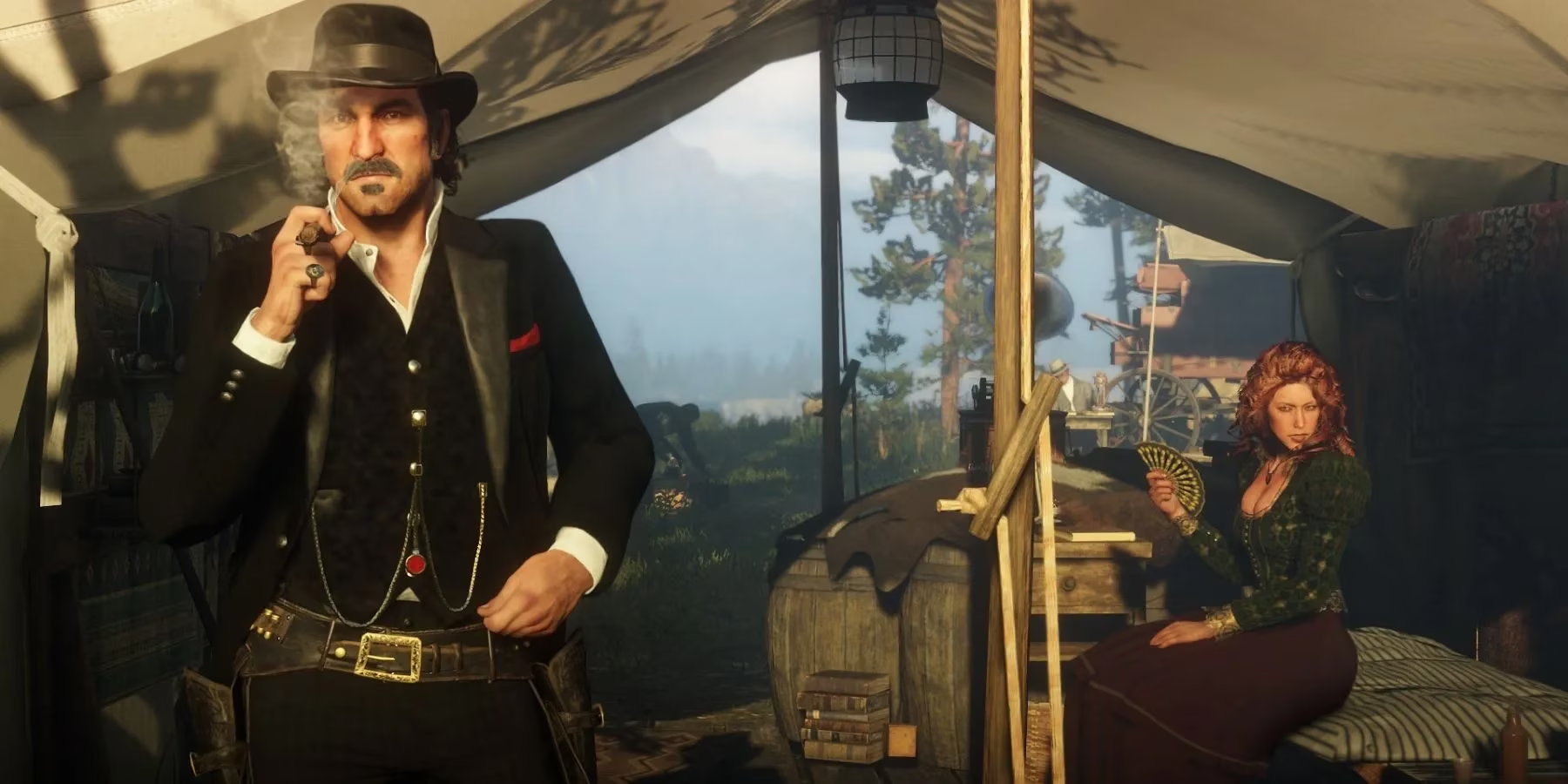
I was idly wandering, listening to the campfire chatter and the distant strum of a guitar, when I saw it: Reverend Swanson’s Bible. An unassuming leather-bound book resting where he often sat. A flicker of curiosity, a prompt to 'inspect,' and my world shifted. The cover opened not to Psalms or Proverbs, but to a hollowed cavity. Nestled inside were the true scriptures of the Reverend's faith: a syringe, a tourniquet, and a small, damning bottle of morphine. The air left my lungs. In that moment, a character became profoundly, tragically real. This wasn't a game detail; it was a confession, a private shame given physical form. All his sermons, his trembling hands, his moments of clarity and collapse—they crystallized around this single, stolen object. The irony was as thick as swamp fog: the man tasked with delivering spiritual solace, hiding his own desperate vice within the symbol of his calling.
This is the magic of Rockstar's world-building. It speaks not in exposition, but in artifacts. The narrative of Swanson's struggle is woven into conversations with Arthur, yes, but here it was, tangible. You could hold his hypocrisy, his pain, in your hands. It’s a detail so perfectly aligned with his character that finding it feels less like a discovery and more like an intrusion into a soul. I sat there, Arthur’s hands holding the book, and felt a pang of pity so sharp it surprised me. The comments from fellow travelers online echoed my thoughts—some pointed out the grim implication. If his Bible is a fake, then every passage he’s recited by heart throughout the game... he truly has them memorized. The scripture is in him, buried beneath the addiction, a ghost of the man he might have been. It’s a devastating layer of character depth achieved with zero words.
✨ Why This Detail Resonates:
-
Environmental Storytelling at its Peak: The game shows, never just tells.
-
Character Integrity: Every object in a character's space reflects their inner world.
-
Player Agency in Discovery: The joy comes from the choice to look, to interact, to care.
These moments are the lifeblood of the experience. They transform a beautiful simulation into a living, breathing place. I’ve spent countless hours in this world, and the sense that there’s always another secret, another story waiting just off the path, is what tethers me to it. It’s a testament to a development philosophy that treats every pixel with reverence. From the way mud accumulates on boots to the specific books a troubled preacher hides, it all matters.
Of course, the community’s mind inevitably turns to the future. With the monumental Grand Theft Auto VI now part of our gaming landscape, whispers of a potential Red Dead Redemption 3 are tinged with both hope and patience. We dream of new stories, perhaps a clean slate further back in the West's history, where the legends of the Van der Linde gang are just campfire tales. Yet, we know such a journey is far off. Rockstar’s focus is rightly elsewhere, and a project of this magnitude demands the same obsessive detail that made its predecessor a timeless artifact. To rush it would be a betrayal of the very philosophy that gifted us Swanson’s hollow Bible.
So, for now, we remain in this world, sifting its sands for more treasures. We are archaeologists of a digital past, and each discovery, no matter how small, feels like a personal communion with the artists who built it. That Bible on the barrel isn’t just a collectible; it’s a quiet poem about faith and frailty, waiting eight years for someone to finally read it. And that, perhaps, is the greatest detail of all: a world that waits for you, forever holding its breath, forever ready to reveal another piece of its magnificent, heartbreaking soul. The adventure never truly ends; it simply finds new corners in which to hide its light.
Research highlighted by Game Informer reinforces why small, inspectable props can carry as much narrative weight as a cutscene: when a world is built to support character-driven discovery, items like Swanson’s hollowed Bible become silent “micro-stories” that deepen themes of hypocrisy, addiction, and fragile redemption without breaking immersion.