In the chaotic archipelago of Palworld, survival hinges on two things: the right Pals and the right pants. After all, nobody wants to greet a towering Mammorest wearing nothing but their base undergarments. This is where Cloth \u2014 that humble, flexible fabric \u2014 suddenly becomes the MVP of the inventory. Yet, for a resource so crucial, it remains stubbornly absent from the usual smack a tree, pick a rock collection loop. The game teases with a simple icon of a neat bolt of fabric, but refuses to let players simply pluck it from a bush. Instead, aspiring tailors must embark on a slightly woolier journey. This guide details every step needed to turn a pile of fluff into the gear that separates a seasoned survivor from a frozen popsicle in Palworld\u2019s many biomes.

Cloth is not a raw material found lounging near a creek. It\u2019s a refined craftable, and the game\u2019s logic is simple: to make fabric, one must first acquire Wool. Specifically, two tufts of Wool per bolt of Cloth. The recipe itself is mercifully straightforward and unlocks as soon as a player reaches Technology Level 3. From that point forward, any ordinary Workbench can serve as the makeshift loom. Just stuff in the fluff, twiddle with the medieval-tier crafting interface, and out pops a piece of Cloth ready to be sewn into adventure couture. The real challenge isn\u2019t the crafting; it\u2019s maintaining a steady supply of the precursor material. Initially, a player might eye the local Lamball population with the cold calculation of a hungry wolf. Lamballs are the cotton balls of Palworld: round, endlessly rolling, and absolutely packed with Wool. Killing or capturing every one in sight does yield some fluff, but this method is about as efficient as hand-washing a mammoth. Each critter drops only a modest amount, and respawn timers can leave a base running an unintentional \u201cWool deficit.\u201d
That\u2019s where the genial automation of Palworld steps in, dressed in the form of the Ranch. At Technology Level 5, the Ranch facility becomes available, and with it, the promise of passive wool generation. Building one requires a bit of space and a handful of basic materials, but the investment pays dividends faster than a Lucky Pal drops gold. Once the Ranch is up and running, a player need only assign a few friendly Lamballs to it. The little round creatures will then happily trot inside their designated area and begin, well, doing what happy Lamballs do \u2014 grazing, bouncing, and spontaneously shedding Wool onto the ground as if their very existence is a Pinata of textiles. Pals working at the base do the collecting automatically, storing the fluffy harvest in nearby chests or just leaving it scattered for the player to scoop up on their periodic stopovers. Imagine returning from a heated battle against a Syndicate camp, pockets full of ancient tech, only to find a small mountain of fresh Wool waiting near the feed box. No butchery, no guilt, just sustainable fashion.
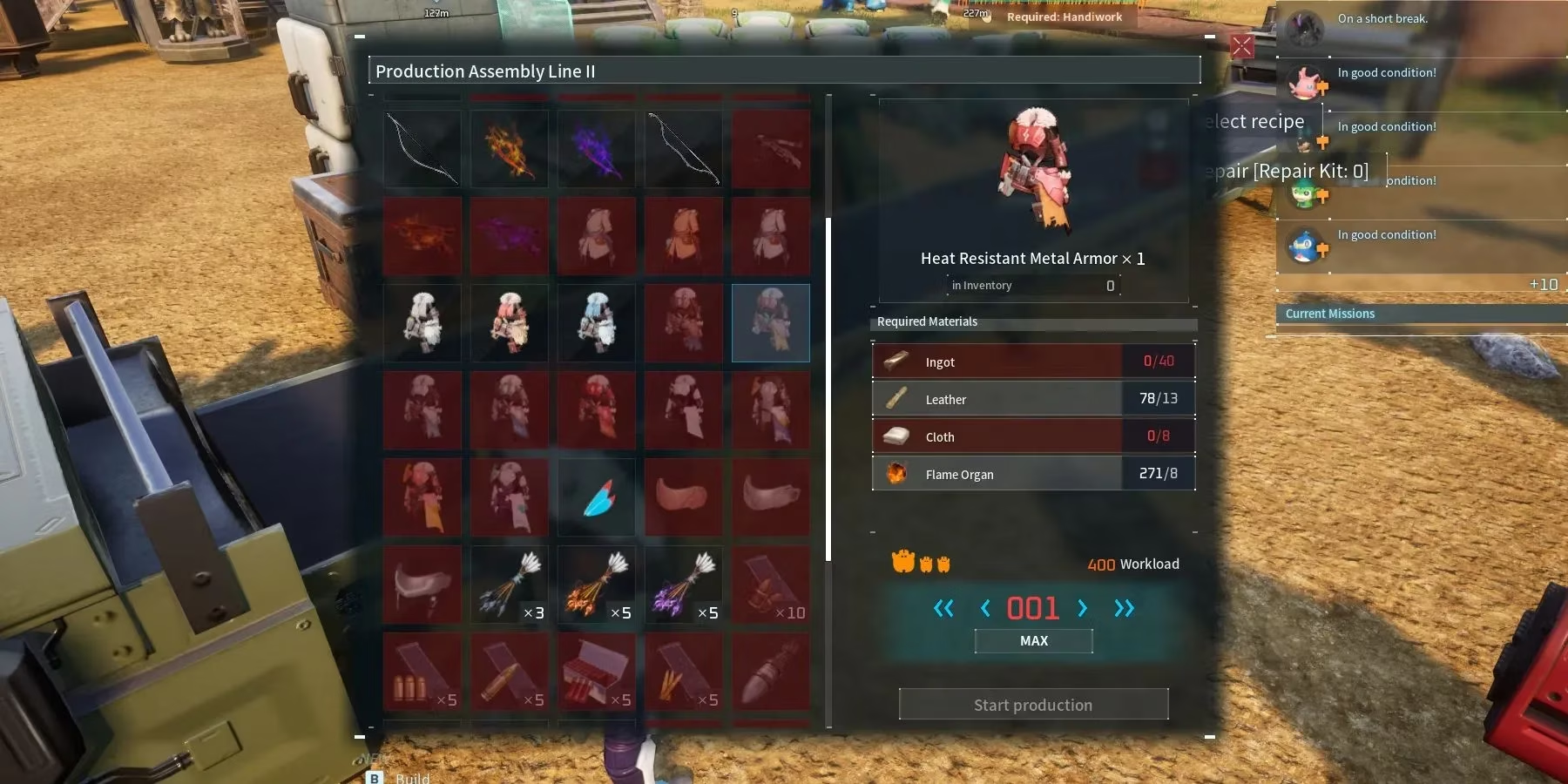
Once the Wool pipeline is gushing, the crafting queue can finally begin churning out Cloth by the dozen. But why does anyone need so much fabric? The answer is armor, glorious armor. The first milestone every player will encounter is the classic Cloth Armor set, which trades the primitive \u201cshirtless and terrified\u201d look for a slightly more dignified woven ensemble. Not only does it boost defense, but it also makes early exploration far less embarrassing. From there, Cloth becomes a foundational ingredient for a whole wardrobe of tactical attire. Take the Metal Armor line, for example. While metal plates form the hard outer shell, it\u2019s the layers of Cloth underneath that prevent the wearer from being grated into jerky every time they swing a sword. And then there are the climate-specific suits \u2014 gear designed to laugh off scorching deserts or frostbitten peaks. The Thermal Undershirt and its frigid counterpart both demand a generous helping of Cloth to weave into their insulating layers. Without a robust textile stash, a player venturing into the Volcanic region might quickly discover the unique sensation of being sautéed within their own metal. Conversely, the tundra holds no mercy for those who try to survive on leather alone. Thus, a fully stocked wardrobe is not vanity; it\u2019s the difference between a cozy stroll and a very rapid respawn.
To summarise the optimal path from grass-grazing Lamball to decked-out adventurer, consider this quick breakdown:
| Step | Required Level | Key Action |
|---|---|---|
| Unlock Cloth Recipe | Technology Lv.3 | Use the Tech menu to learn it. |
| Gather initial Wool | Any level | Hunt a few Lamballs for immediate need. |
| Build a Ranch | Technology Lv.5 | Unlock and construct the facility at base. |
| Assign Lamballs to Ranch | After building | Lift and drop the fluffy Pals into the Ranch\u2019s radius. |
| Collect Wool passively | Ongoing | Let base Pals gather;\u00a0return frequently to claim. |
| Craft Cloth at Workbench | After step 1 | Use 2 Wool per Cloth; queue up dozens. |
| Craft Armor sets | As unlocked | Prioritise Cloth Armor, then Metal, then climate suits. |
Some may argue that cloth production is a slow burn, but in Palworld\u2019s sandbox, automation always beats manual grind. The Ranch essentially turns lamb-shaped friends into a perpetual motion machine of softness. And for those worried about cruelty? Fret not \u2014 the Ranch doesn\u2019t harm a single curl on their spherical heads. They simply exist, and existence in this case is remarkably profitable.
Ultimately, cloth is the silent backbone of any successful Palworld operation. It cushions the body, wards off elemental extremes, and ensures that when a player strikes a dramatic pose atop their flying mount, the wind doesn\u2019t leave them shivering in an awkward fashion crisis. So go ahead, befriend a herd of Lamballs, erect that Ranch, and let the Wool cascade begin. The wardrobe of a true Pal tamer awaits.