The world of Teyvat has grown beyond anyone's wildest dreams. What started as a humble journey through Mondstadt's breezy hills and Liyue's towering peaks has become a sprawling tapestry of nations, islands, deserts, and hidden underground realms. With Version 7.0, Everwinter Without Mercy, now live since August 12, 2026, Snezhnaya has finally thrown open its frozen gates—and the official interactive map has expanded right alongside it.
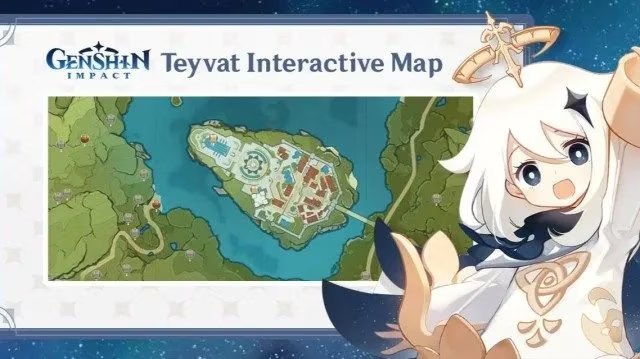
So, you're a new Traveler plotting your first route? Or a veteran chasing every last chest in Nod-Krai? Either way, knowing when each region arrived and how the map layers work can save you hours of aimless wandering. Let's take a stroll through Teyvat's cartographic history—and pick up some practical tips along the way.
The Version Timeline: How Teyvat Grew
Mondstadt and Liyue formed the original Version 1.0 map back in September 2020. Since then, the world has expanded in waves. Here's a quick reference table for the major permanent additions:
| Version | Region / Area | Notes |
|---|---|---|
| 1.0 | Mondstadt, Liyue | Original explorable map |
| 1.2 | Dragonspine | First permanent subregion |
| 2.0–2.2 | Inazuma islands | Narukami, Kannazuka, Yashiori (2.0); Watatsumi, Seirai (2.1); Tsurumi (2.2) |
| 3.0 | Sumeru | Rainforest region |
| 3.1 | Sumeru Desert | First desert areas |
| 3.4 | Desert of Hadramaveth | Expansion |
| 3.6 | Gavireh Lajavard, Realm of Farakhkert | Further desert expansion |
| 4.0 | Fontaine | Introduced underwater exploration and multi-layered maps |
| 4.4 | Chenyu Vale | Part of Liyue, connects to Fontaine border |
| 5.0 | Natlan | First part |
| 5.2, 5.5, 5.8 | Natlan expansions | Including Easybreeze Holiday Resort (permanent) |
| Luna I (Sept 2025) | Nod-Krai | Major region, official title "Luna I" |
| Luna IV, Luna VIII | Nod-Krai expansions | Lunar exploration areas with special layers |
| 7.0 (Aug 12, 2026) | Snezhnaya | First explorable areas: Volkodlak Tundra, White Birch Snowgrave, Everfrozen Earth, Flamefeather Valley, Fellfrost Peak |
Phew! That's a lot of ground to cover. But wait—there's more to the map than just surface regions.
Separate Maps vs. Layered Maps: Know the Difference
Some areas look like they belong to the main Teyvat map but actually use separate map screens or independent exploration layers. For example:
-
Enkanomiya is an underground civilization accessed through Watatsumi Island. It uses its own map instead of appearing directly on the standard Inazuma overworld.
-
The Chasm has its surface as part of Liyue, while The Chasm: Underground Mines opens on a separate map with multiple internal layers.
-
The Sea of Bygone Eras is accessed through Petrichor and its related questline. It has its own map and dedicated underwater routes.
-
Luna VIII's lunar exploration areas use special layers connected to the "Moon Gazing" quest. Access depends on quest progression.
Don't confuse multi-layered maps with fully separate maps. Regions like Sumeru, Fontaine, Natlan, and Snezhnaya can contain underground or elevated layers while still belonging to the main regional map. Always check the layer selector before you travel—especially in dense areas. Trust me, you don't want to spend twenty minutes climbing a mountain only to realize the pin is in a tunnel beneath your feet.
The Interactive Map: Your Best Friend
The official HoYoLAB Teyvat Interactive Map is your best tool for locating collectibles, enemies, waypoints, puzzles, and farming materials. For a cleaner view, select one region first and enable only the marker categories you need. The map can display:
-
Elemental Oculi and regional collectibles
-
Treasure Chests and Shrines of Depths
-
Teleport Waypoints and Statues
-
Local Specialties
-
Common and Elite Enemies
-
Normal and Weekly Bosses
-
World Quest starting points
-
Puzzles and Time Trial Challenges
-
Fishing Points
-
Wood, ores, plants, and cooking ingredients
HoYoLAB has expanded the interactive map alongside the game: Sumeru arrived in Version 3.0, Fontaine added underwater exploration in Version 4.0, Natlan followed in Version 5.0, Nod-Krai opened in Luna I, and Snezhnaya was added with Version 7.0.
Practical Tips for Explorers
Here are some tricks to keep your sanity while exploring:
-
Enable only relevant markers. Showing every chest, enemy, and resource at once can turn a dense area into a cluttered mess.
-
Complete major World Quests first. In regions like Sumeru, Fontaine, Natlan, Nod-Krai, Enkanomiya, and The Chasm, quests can unlock entrances, remove barriers, change terrain, or reveal new map layers.
-
Clear one subregion at a time. Finishing one Inazuma island or one Sumeru desert area before moving on makes it easier to track completed pins and spot missed items.
-
Check elevation and map layers before traveling. A nearby pin may actually be inside a tunnel, underground chamber, or elevated route with an entrance much farther away.
-
Combine farming routes. For material farming, group Local Specialties, enemy drops, and nearby Teleport Waypoints into short regional loops.
Also, remember that the interactive map is not a perfect automatic record of every chest you've already opened. Use its marker controls as a separate exploration checklist and update completed pins manually.
A Note on Temporary Maps
Genshin Impact has used temporary maps for summer events and other limited-time content. These areas disappear after their event version ends, so they are not included in the permanent map timeline. If you're looking for an older event map, check whether the area was temporary before trying to reach it in the current version. One exception: Easybreeze Holiday Resort was added as a permanent Natlan area in Version 5.8, even though limited-time summer activities were held there.
Snezhnaya Is Finally Here
Version 7.0, Everwinter Without Mercy, went live on August 12, 2026, and made Snezhnaya explorable for the first time. The initial release includes Volkodlak Tundra, White Birch Snowgrave, Everfrozen Earth, Flamefeather Valley, and Fellfrost Peak. If you have completed Archon Quest Prologue: Act III "Song of the Dragon and Freedom," a Teleport Waypoint southwest of Volkodlak Tundra unlocks automatically, giving you a direct route into the region.
The region is part of the main Teyvat map and can be explored through the official interactive map. So bundle up—it's cold out there.
Wrapping Up
From Mondstadt and Liyue in Version 1.0 to Snezhnaya in Version 7.0, the Genshin Impact map has grown into a network of nations, islands, deserts, underwater areas, underground regions, and separate exploration maps. Use the version timeline when you want to check when a region was added, and use the HoYoLAB interactive map when you need exact locations for collectibles, enemies, resources, or waypoints.
Whether you're a fresh-faced Traveler or a grizzled veteran, Teyvat's map will keep you busy for years to come. And honestly, who doesn't love a good treasure hunt? Just remember to check those layers. Happy exploring!