Even now, in 2026, the world of Red Dead Redemption 2 continues to breathe and reveal its secrets. It's been nearly a decade since Arthur Morgan first rode into our lives, and yet, the game's sprawling, melancholic depiction of the dying Wild West feels as fresh and profound as ever. I thought I knew every crease of Arthur's weathered face, every gruff line in his journal, every subtle shift in his demeanor as his story unfolded. But the community, ever-vigilant and deeply connected to this digital frontier, keeps unearthing layers of humanity in this character that I, and I suspect many others, had completely overlooked. The latest discovery isn't about a hidden treasure or a secret weapon; it's about a single, quiet tear.
I remember my first playthrough. I was reckless, treating Arthur like a video game avatar—a vessel for my own chaotic whims. I'd charge into gunfights, tumble down ravines, and yes, even watch his horse meet an untimely end, all with a detached sense of amusement. The game's systems were so robust, the physics so hilariously unpredictable, that causing mayhem became a pastime. But recently, a player shared a revelation that stopped me cold. They zoomed in, really looked at Arthur's face after a nasty fall from a cliffside path. There, tracing a path through the dust and grime on his cheek, was a tear. Not a dramatic sob, not a cry of pain, but a silent, solitary expression of pure, vulnerable hurt.
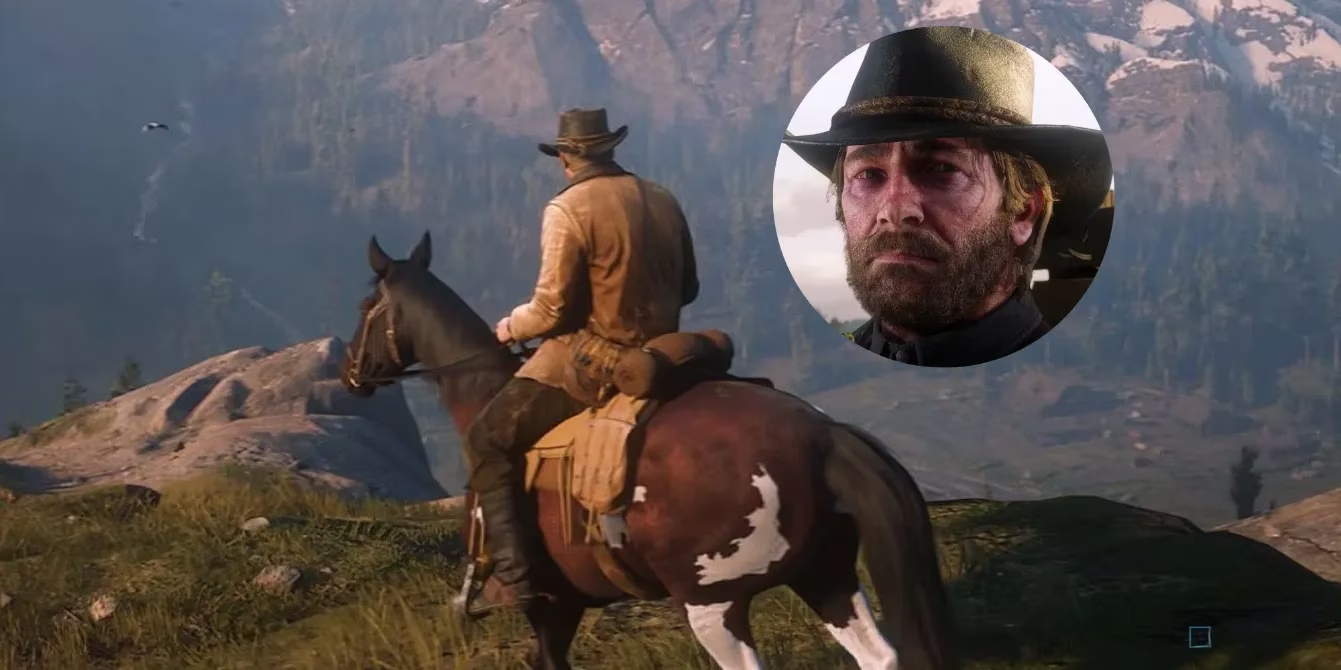
This small detail, missed by so many of us in our years of play, speaks volumes about the monumental care Rockstar poured into Arthur Morgan. It's not just about the breathtaking landscapes or the intricate combat; it's about soul. Arthur isn't just a collection of polygons and voice lines reacting to damage metrics. He's a man. When he's injured, he doesn't just grunt and lose a health bar—he feels it. He internalizes the shock, the pain, the frustration, and for a fleeting moment, that internal struggle breaches the surface. This emotional granularity transforms him from a protagonist you control into a person you inhabit, whose burdens you eventually feel as your own.
Reflecting on it now, the signs were always there, woven into the fabric of his character:
-
The Journal: His sketches and writings reveal a contemplative, artistic soul beneath the outlaw exterior.
-
Camp Interactions: The way he gently speaks to Jack, offers advice to the gang members, or sits alone by the fire, lost in thought.
-
Honor System: The game's core mechanic isn't just about "good" or "bad" choices; it's about shaping Arthur's own perception of himself, a struggle reflected in his self-portrait in the journal.
The tear is the physical manifestation of all that unseen emotional labor. It's a detail that asks a poignant question of the player: What kind of man are you making him? Every reckless decision, every cruel act, isn't just a statistic on an honor bar; it's a weight on Arthur's conscience, a small crack in his spirit that can, quite literally, bring him to tears. I feel a profound sense of guilt now for all those times I treated his journey with cavalier disregard. 😔
This discovery underscores why Red Dead Redemption 2 remains a benchmark for narrative-driven open worlds. Its longevity isn't just about gameplay patches or graphical fidelity, though the surprise 2026 stability update was a welcome nod to its enduring player base. Its longevity is rooted in a depth of character that continues to resonate and reveal itself years later. The environments aren't just pretty backdrops; they're silent witnesses to Arthur's internal battles. The supporting cast aren't just quest-givers; they're mirrors reflecting different facets of his complex personality.
| Then (2018) vs. Now (2026) | Focus of Player Discovery |
|---|---|
| At Launch 🎮 | Hidden locations, secret weapons, optimal mission strategies, glitches. |
| Today 🔍 | Micro-expressions, environmental storytelling subtleties, character psychology, and emotional nuance. |
We've moved from mapping the land to mapping the heart. In another few years, I have no doubt we'll still be finding new reasons to marvel at this masterpiece—perhaps a new, previously unnoticed line of dialogue that changes a scene's context, or a specific play of light at a certain time of day that highlights a forgotten detail in camp. The world of Red Dead Redemption 2 is so densely packed with intention that it feels alive, evolving in our perception long after the credits have rolled.
So, if you find yourself booting up the game again in 2026, I urge you to do something different. Slow down. Walk instead of gallop. After a skirmish or a fall, don't immediately reach for a health cure. Take a moment. Zoom in on Arthur's face. Look into his eyes. You might just see the ghost of a tear, a silent testament to the fact that even in a virtual world, pain is real, regret is tangible, and the most powerful stories are the ones that make us feel, deeply and truly, for someone who isn't even there. That is the unforgettable legacy of Arthur Morgan, a character whose hidden tears remind us of the incredible power of interactive storytelling.