In the vast, ever-evolving landscape of interactive entertainment, few achievements shimmer with the sustained brilliance of Rockstar Games' creations. How does a title, born in 2013, continue to command the attention of millions a decade later? The answer lies not merely in the sun-drenched, chaotic streets of Los Santos or the windswept, morally complex plains of the American frontier, but in the living, breathing worlds that players are invited to inhabit and shape. The stories of Grand Theft Auto V and Red Dead Redemption 2 are testaments to a modern alchemy, where narrative ambition is fused with the boundless potential of persistent online spaces and the deeply human desire to role-play.
The Unprecedented Longevity of a Modern Classic
Grand Theft Auto V stands as a colossus, a title that has transcended its status as a mere game to become a cultural fixture. With sales surpassing a staggering 200 million copies, its success is a narrative woven across three console generations. Yet, the secret to its enduring heartbeat is not found solely in its cinematic heists or satirical world-building. Is it simply the re-releases that have kept it alive? While accessibility across platforms has undoubtedly introduced it to new audiences, the true lifeblood has been Grand Theft Auto: Online. This persistent, ever-expanding universe became the canvas upon which players could paint their own stories. Instead of traditional single-player expansions, Rockstar poured creativity into this digital sandbox, offering a relentless stream of new content—from high-stakes business ventures to outlandish adversarial modes. This strategy transformed the game from a finite experience into a service, a virtual playground where one could be a ruthless CEO, a daring stunt driver, or simply a citizen of Los Santos causing benign chaos. The ability to embody not just player-created avatars but also beloved characters like Lamar Davis added a layer of role-playing depth that kept the community engaged, year after year.
A Tale of Two Online Frontiers
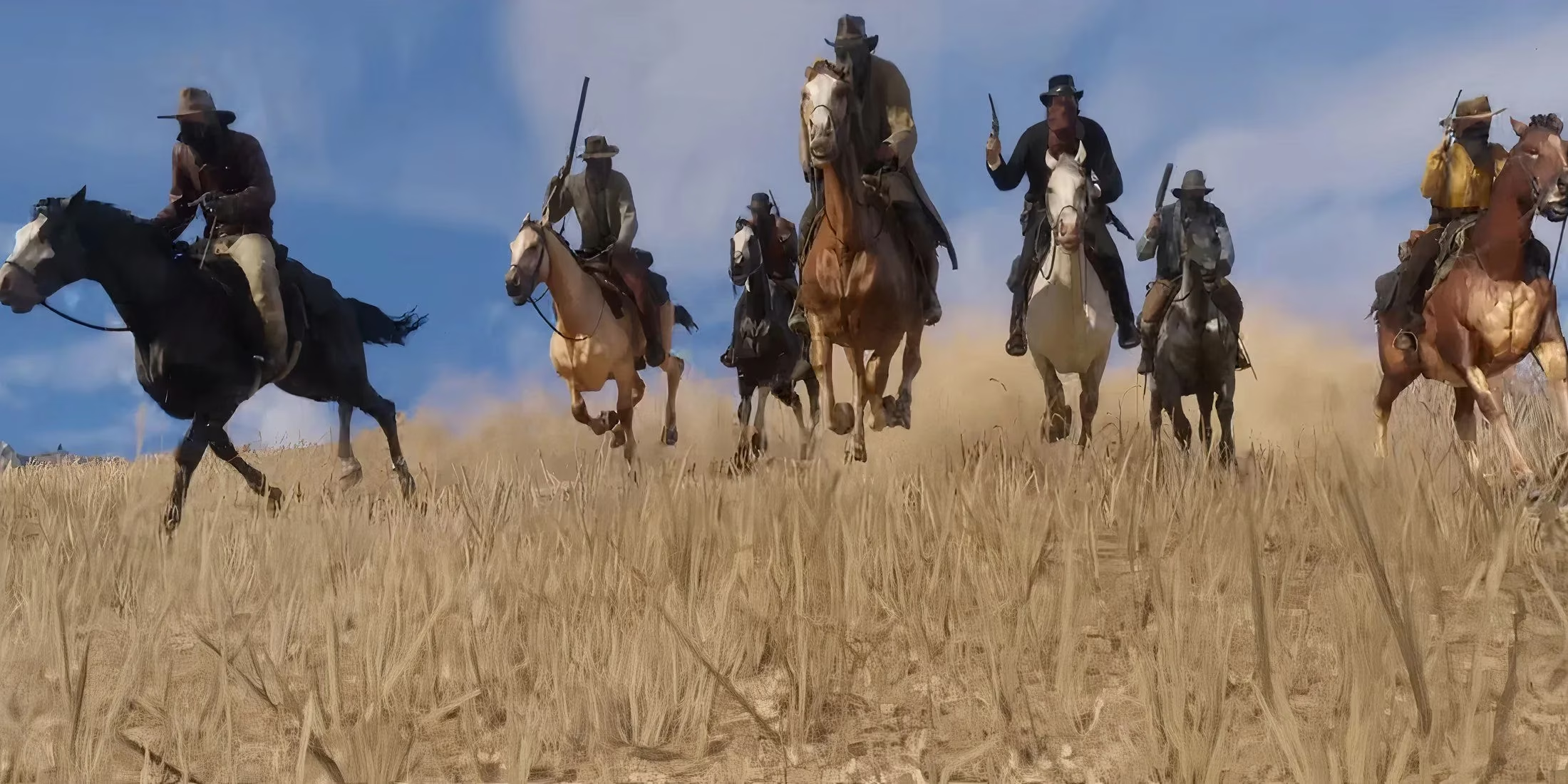
The journey of Red Dead Redemption 2's companion, Red Dead: Online, tells a more nuanced, perhaps bittersweet, tale. While the base game itself is a masterpiece of storytelling, selling over 64 million copies, its online counterpart faced unique challenges. It offered a breathtaking, immersive world of untamed wilderness and frontier towns, ripe for role-playing as a trader, bounty hunter, or moonshiner. However, could it capture the same magic? Players encountered server instability, an economy that sometimes felt punishing, and the perennial issue of disruptive 'griefers.' Moreover, the flow of substantial new content eventually slowed to a trickle, especially when compared to the constant evolution of its urban cousin. Despite these hurdles, Red Dead: Online cultivated a dedicated, passionate community. It demonstrated the immense, yet only partially realized, potential of a shared, living Old West—a potential that still whispers on the wind, waiting for another chance.
| Feature | Grand Theft Auto: Online | Red Dead: Online |
|---|---|---|
| Core Strength | Constant content updates, diverse role-play opportunities, player-driven economy. | Immersive atmospheric world, deep role-playing potential in a historical setting. |
| Key Challenge | Managing griefers, maintaining balance with new powerful items/vehicles. | Slower content pipeline, balancing frontier authenticity with engaging gameplay loops. |
| Community Role | Central to experience; defines meta and popular activities. | Niche but deeply invested; focuses on atmosphere and cooperative play. |
The Road Ahead: Learning from the Past for Future Legends
As we look toward 2026 and beyond, the horizon is illuminated by the impending dawn of Grand Theft Auto VI and the hopeful whispers of a future Red Dead Redemption 3. The lessons from the past decade are clear and compelling. For GTA VI, the blueprint for a decade-long reign already exists, but it requires meticulous refinement. The upcoming online mode must be built on a foundation of fair play and robust moderation from day one. Preventing bad-faith actors from spoiling the fun is not an optional feature; it is essential infrastructure. Furthermore, the role-playing tools must be expanded and deepened. Imagine a character creator with unprecedented detail, social spaces that feel truly alive, and systems that allow players to craft narratives as rich as those written by Rockstar's own writers. The 'Director Mode' concept should evolve, giving players even more control to stage their own stories within the vibrant chaos of (presumably) Vice City.
For a hypothetical Red Dead Redemption 3, the online component represents a monumental opportunity for redemption in its own right. Rockstar has the chance to fully realize the promise that Red Dead: Online hinted at. This would require a commitment not to let it languish in the shadow of its urban sibling. A steady, meaningful stream of content tailored to the Western fantasy—new frontiers to explore, deeper homestead mechanics, more intricate trade routes—would be paramount. The role-playing systems must be even more robust, with clothing, weapon customization, and character progression that makes every cowboy, outlaw, or lawman feel unique. Can the quiet drama of a campfire under a starry sky compete with the neon-soaked frenzy of a city? With the right care, it absolutely can, offering a profoundly different but equally compelling form of escapism.
The Delicate Balance: Single-Player Soul vs. Multiplayer Might
A quiet dissent persists among some fans—a longing for the focused, expansive single-player DLCs of a bygone era, like The Lost and Damned or The Ballad of Gay Tony. There is a valid concern that the immense resources required to maintain these online leviathans divert energy from what many consider the heart of Rockstar's genius: crafted, authored narratives. Yet, can one deny the financial and cultural reality? The strategy has created ecosystems that sustain themselves and their communities for years, funding the ambitious development cycles of these monumental games. The challenge, and the art, for Rockstar moving forward will be to ensure that the soul-stirring, narrative depth of its single-player worlds is not just preserved but enhanced by the lessons learned from fostering these vast, player-driven societies. The future lies not in choosing one over the other, but in mastering the harmony between a timeless, directed story and an endless, player-authored one. In the end, it is the power to be someone else, whether following a predetermined path or forging one's own, that continues to be the most potent spell in Rockstar's book.