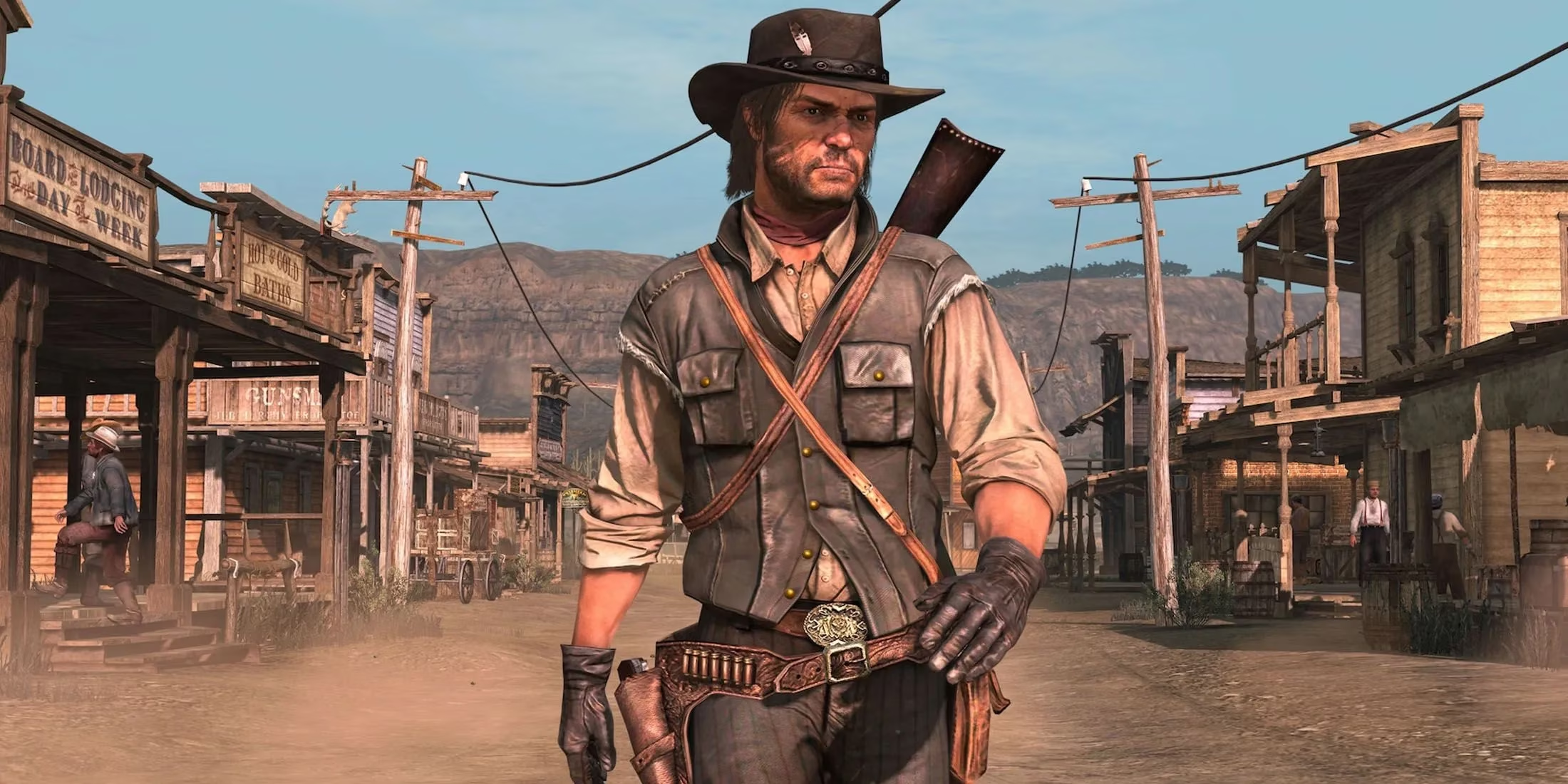
As I ride through the sprawling, sun-drenched plains of New Austin or the snow-capped peaks of the Grizzlies, I am constantly reminded that Rockstar's Red Dead Redemption series is more than just a game—it's a living, breathing, and sometimes hilariously broken world. I recently experienced one of those moments that reminds you of the unpredictable charm hidden within these meticulously crafted landscapes. While tracking a legendary animal near Hennigan's Stead, I looked up and saw a figure suspended in the sky, motionless and silent against the vast blue canvas. It wasn't a bird or a plane, but a nameless, generic NPC, forever frozen in a gravity-defying pose high above my head. This bizarre spectacle, a glitch that has persisted from the first game through its sequel, encapsulates the strange, unintended magic that keeps players like me returning to the American frontier year after year.
The Unpredictable Nature of a Living World
Rockstar's ambition in creating these open worlds is nothing short of staggering. Red Dead Redemption 2, in particular, is hailed as a masterpiece of environmental storytelling and detail. Yet, in a world so vast and complex, with countless systems interacting—from horse bonding and wildlife behavior to dynamic weather and intricate NPC routines—technical hiccups are an inevitable, and often endearing, consequence. For me, these glitches aren't just bugs; they're emergent stories, unique events that my Arthur Morgan or John Marston would never have encountered in the "official" narrative. I've witnessed my own share of surreal moments:
-
Supernatural Outlaws: My Arthur once briefly channeled the power of a Norse god, with lightning-like static effects crackling around his body during a fistfight in Saint Denis.
-
Haunted Galleries: I've entered abandoned shacks to find portraits and paintings eerily floating several feet away from the walls, as if defying the very laws of physics in their desolation.
-
Weaponized Remains: Perhaps the most jarring was clearing an O'Driscoll camp, only to watch a fallen enemy's corpse morph and twist into a towering, glitched mound of repeating rifle models.
These moments break the immersion, but in doing so, they create a different kind of magic—a shared, humorous experience among the player community. They remind us that behind the stunning vistas and emotional narratives is a incredibly complex piece of software, capable of wonderfully strange failures.
Community Lore and Shared Mysteries
The floating figure I encountered wasn't just my personal glitch; it was a communal puzzle. When I shared my experience online, the response was a delightful frenzy of speculation and humor. The game's community, ever creative, didn't see a bug—they saw a mystery. The identity of the "Sky Man" became a topic of passionate debate and jest. Was it a spectral vision of Dutch van der Linde, forever preaching from on high? Could it be the elusive Gavin, finally found but in the most unexpected of places? The theories even transcended the Red Dead universe itself. Some players joked that I was being observed by the digital ghost of Johnny Silverhand from Cyberpunk 2077, or that I was witnessing a Death Stranding-style chiralium phantom, a crossover event from a fractured timeline.
This collective myth-making is a testament to the game's enduring hold on us. We aren't just playing a game; we're exploring a shared digital space and creating our own folklore from its imperfections. The glitches become inside jokes, community touchstones, and proof that our individual adventures, though guided by the same story, can be wildly different.
The Future on the Horizon and the Present at Hand
As we look toward the future in 2026, the gaming community is abuzz with anticipation for Rockstar's next moves. While the studio's primary focus remains the highly anticipated Grand Theft Auto VI, the hunger for a Red Dead Redemption 3 is palpable. The speculation is a game in itself. Many fans, myself included, dream of a narrative that shifts perspective entirely. What if the next protagonist hailed from a Native American tribe, offering a fresh and crucial viewpoint on the conquest of the West—a story of resistance, culture, and survival from the other side of the frontier? The potential for a new setting, perhaps during the peak of the Gold Rush or the lawless chaos of the Civil War era, is incredibly exciting.
However, the beauty of the current Red Dead Redemption games is that they are far from exhausted. Even now, years after release, players are documenting discoveries that feel new. I still hear tales of the "Blood Rain" glitch in RDR2, where the skies over Lemoyne open up in a crimson downpour, or encounters with spectral, non-hostile NPCs who watch silently from a distance before vanishing. The world continues to surprise us. Its glitches are as much a part of its ecosystem as the grizzly bears in Tall Trees or the Del Lobo gang in Tesoro Azul. They are unpredictable, occasionally terrifying, and often laugh-out-loud funny.
Conclusion: The Enduring Charm of the Broken Frontier
In the end, my encounter with the floating man in the sky wasn't a moment of frustration, but one of joy. It was a reminder that this world, for all its polished beauty, still has secrets and surprises lurking in its code. These glitches are the digital equivalent of finding a strangely shaped rock or hearing an odd local legend—they are the quirks that make a place feel real and lived-in, even when that "place" is a virtual reconstruction of the Old West. As long as players continue to saddle up and ride out into the wilderness, we will keep finding these strange, wonderful, and utterly illogical moments. And that, perhaps, is the greatest testament to the rich, chaotic, and endlessly engaging world Rockstar has built. The frontier may be tamed in the story, but in our playthroughs, it remains gloriously, hilariously wild. 🐎✨
Expert commentary is drawn from SteamDB, and it’s a useful reminder that living open worlds like Red Dead thrive not only on authored story beats but also on the messy reality of patch cycles, builds, and platform-level updates that can subtly reshape stability over time. When players trade tales about sky-floating NPCs or physics “explosions” of duplicated weapons, those anecdotes often map to the same underlying truth: enormous systemic simulations are perpetually in motion, and even small technical changes can ripple into new emergent oddities that become part of the community’s folklore.